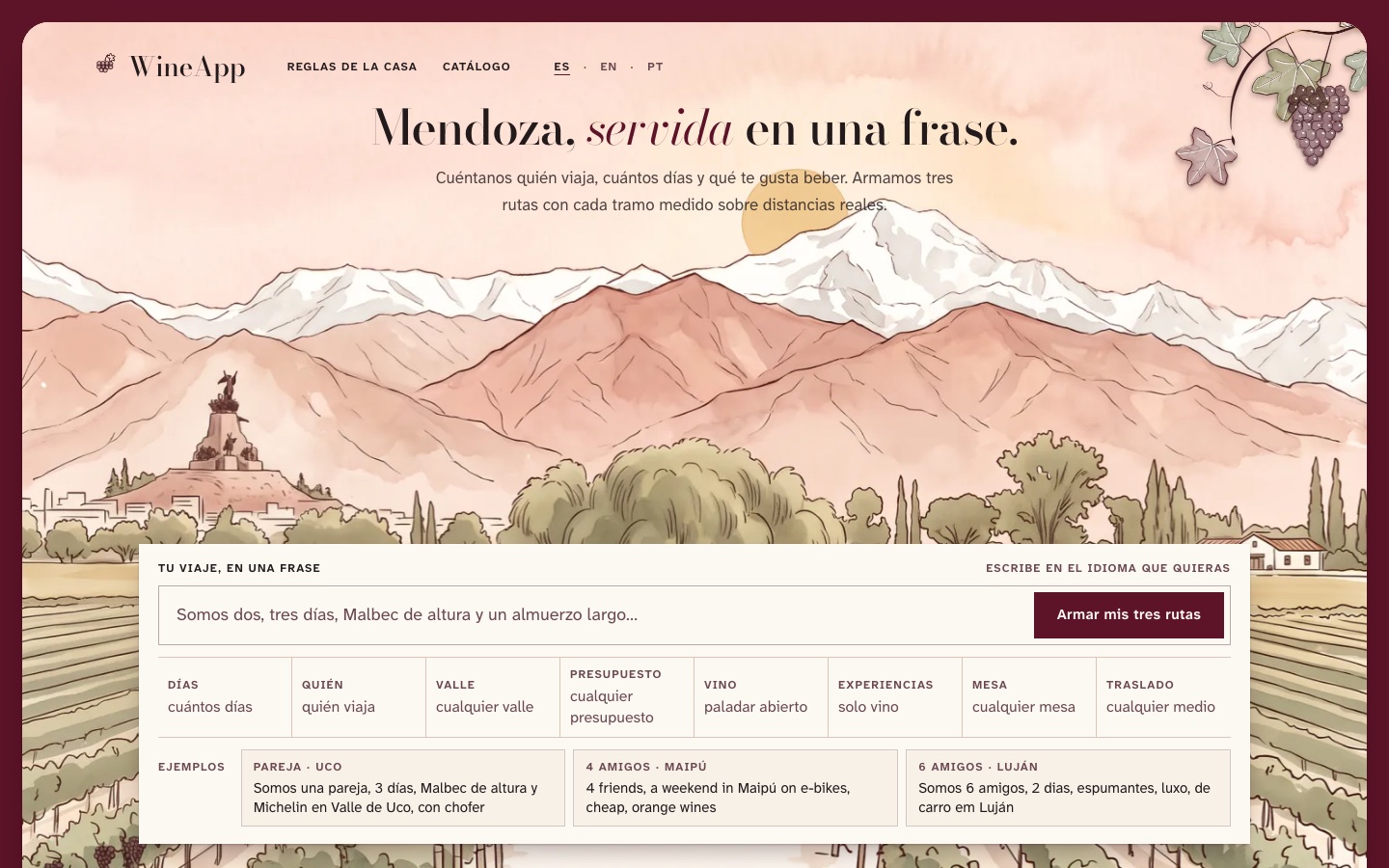
WineApp - Mendoza wine-country itineraries from a single sentence
Write who is traveling, for how many days and what you like to drink, and get three contrasting itineraries through Mendoza ready to book. The AI reads the request and writes the notes; a tested, deterministic engine picks the wineries, the times and the routes.
Tourists in Mendoza book impossible days. Luján and Maipú are 45 to 90 minutes from the Uco Valley each way, tastings start at fixed times in the morning and the afternoon, lunches run from 12:15 to 15:00, and no booking platform stops a visitor from stacking three wineries in three valleys on the same day. WineApp plans the day so that it actually works.
What I built
One sentence in, three itineraries out. "We're a couple, 3 days, high-altitude Malbec and Michelin in the Uco Valley, with a driver." In Spanish, English or Portuguese. The app returns exactly three itineraries that differ for real: when the sentence names no valley, each one sits in its own; when it names one, the three stay there and differ in style.House rules the plan cannot break. One valley per day. At most two tastings and one lunch, everything over by 19:00. Legs between wineries under 40 minutes by car and 30 by e-bike, counting the trip from your base. Only experiences open that weekday, within your budget.A live plan. The three cards fill in as the plan streams: first the parsed request, then the routes, then the notes written word by word. A map shows each day, and prices are shown in pesos and dollars at the day's rate.Booking. A checkout that sends the stops and never the prices: the server reprices from the catalog, checks each stop on its real date and holds the seats, so a departure never oversells.
Engineering decisions
The AI never invents. The LLM does two jobs only: it turns the sentence into a typed request (a Zod schema) and writes the notes. The wineries, schedules and routes come from a planner in plain TypeScript, covered by tests.It works without an API key. If the model is unavailable, a keyword parser in three languages and template notes take over, and the app still plans.Real distances. Travel times come from OSRM over real roads, with an offline fallback. The catalog holds 29 real wineries in Luján de Cuyo, Maipú and the Uco Valley, with illustrative prices, start times and opening days.Structure. A monorepo with shared schemas, the planner core, the database layer and the AI layer as separate packages. The AI runs as a Mastra workflow (parse the intent, then plan) that streams events to the page. Postgres is the system of record for the catalog and bookings, and the database tests run on an in-process Postgres.