Trevis AI - Simulated shift for screening call center candidates
B2B platform for contact centers: the candidate works a real shift on a simulated help desk, with tickets, policies and a customer who reacts over chat. The recruiter gets a report with evidence, never an automated verdict.
A contact center hires the same role every month, and the tool for choosing still hasn't changed: a screening call or a video interview. There you see how someone talks about themselves, not how they handle a customer who lost an order. You find out the difference after paying for weeks of training, and when the person underperforms or quits, you start over. The interview rewards whoever sells themselves well, not whoever solves.
The shift, not the interview
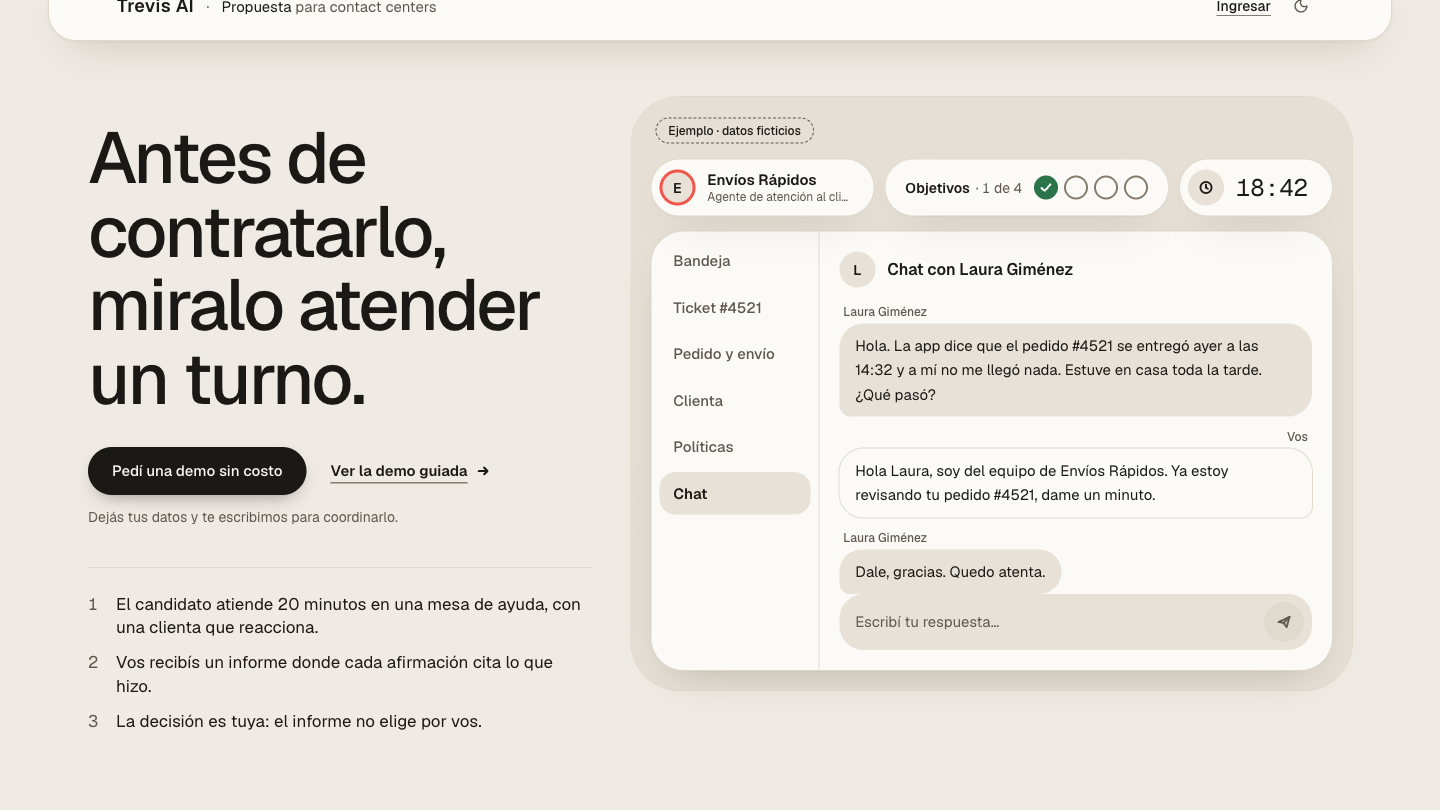
Trevis replaces that conversation with a real shift. The candidate opens a link, no account, no install, and for about 20 minutes works in the internal tool of a fictional company, Envíos Rápidos: reads tickets and policies, checks the order and the customer profile, and chats with a customer who reacts to whatever the candidate answers. Midway through the shift an urgent ticket arrives. There are four objectives: find out what happened with order #4521, resolve it per policy, reply to the customer with the solution, and confirm the amount of each installment. The candidate knows from the start that the customer is an AI and that a person makes the decision.The shift can't be solved by writing nicely. You have to find the data in the internal documents and apply the right policy, which is the answer to the obvious "what if they use ChatGPT?": without searching the simulated help desk, there's nothing to paste.
The report, not the verdict
Every claim in the report cites what the candidate did, with the exact minute: what they checked before deciding, whether they got it right, how they explained it, how long it took. It adds strengths, what to dig into in the interview, and integrity signals - paste events, whether they left the window, typing rhythm (speed and corrections, never deleted content). Integrity is information, not proof. The report never says "hire" or "reject": that decision stays with the recruiter.
Design decisions
Two models do different jobs and never overlap. One plays the customer. Another grades each item of a quality rubric citing the candidate's actions. The final recommendation - Recommended, With reservations, Not recommended - comes from fixed rules applied over that rubric, not from the model, and someone on the client's team records the decision.Under the hood, each role is an agent built with Mastra, with its own subagents and skills for each part of the job: playing the customer, reading the policies, scoring the rubric. Models are consumed through OpenRouter, so each agent can use the model it needs without tying the product to a single provider.The candidate's name stays in the client panel and is never sent to an AI model. The clock runs on the server: closing the tab and reopening the same link resumes the shift where it left off; if the AI customer doesn't answer, the clock pauses and the candidate can retry.
Today
Available roles are customer service, telecom/internet billing, internet tech support, gas utility service, and inbound and outbound sales. For a pilot, the shift is built with the client's own policies and typical cases.The business model is a free pilot with 5 to 10 real candidates from a search the client already has open, then pay per evaluated candidate in prepaid packs, no monthly subscription. There's no integration: the recruiter sends the link over WhatsApp or email, and reports land in a panel, exportable to CSV or for printing. If the report doesn't tell the recruiter anything they didn't already know, it stops there.The site also includes an in-browser training-cost calculator: the numbers are never stored or sent.